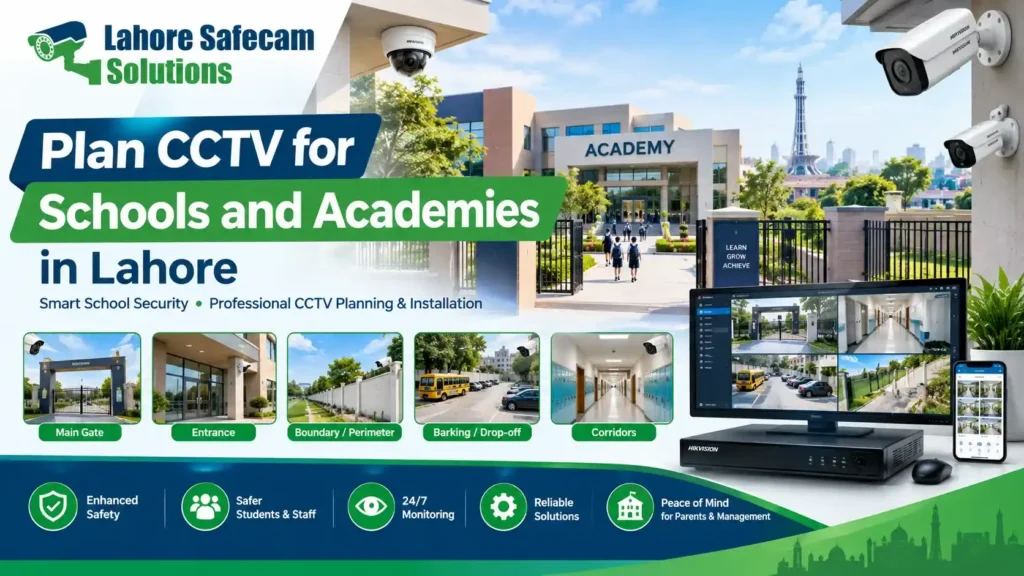
A camera above the school gate can make a campus look protected, but that does not mean the CCTV system is actually useful. If faces are unclear, important routes fall into blind spots, recording stops during a power cut, or footage cannot be found when needed, the system has failed at the planning stage. For CCTV for schools in Lahore, good planning starts with the areas that genuinely need monitoring. Entrances, exits, corridors, boundary access, reception areas, parking spaces and other shared locations should be assessed before deciding how many cameras to buy.
This has become particularly relevant for educational institutions in Punjab. In December 2025, the Punjab government directed authorities to strengthen security around schools and other educational institutions, including the use of functional CCTV, security guards, and entry checking. A useful school surveillance system, however, is not created simply by putting cameras everywhere. It requires careful decisions about coverage, privacy, recording, storage, access, and power backup.
Start With the School Layout, Not the Camera Package
Every school or academy operates differently. A small tuition academy occupying one floor may have one entrance, a reception desk, several classrooms, and a staircase. A larger school could have separate gates for students and staff, playgrounds, laboratories, administrative blocks, parking spaces, and several boundary access points. That is why buying an eight-camera or sixteen-camera package before assessing the site can be a mistake.
Start by walking through the property and asking:
- Where can someone enter or leave?
- Which routes are used most frequently?
- Are there places hidden from staff view?
- Which locations require clear identification rather than general observation?
- What happens after school hours?
- Which outdoor areas need monitoring at night?
Punjab Police has previously emphasised controlled entry and exit points and CCTV monitoring around educational institutions in Lahore. The number of cameras should therefore follow the security plan rather than determine it.
Which Areas Should School CCTV Cover?
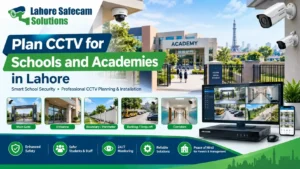
The most useful CCTV cameras for schools are usually positioned where there is a clear monitoring purpose.
Entrances and Exit Gates
Main gates deserve particular attention because they are the point where students, staff, parents, visitors, and vehicles enter the premises. A camera here should provide more than a distant view of general movement. The angle, height, lighting and resolution should allow useful identification where appropriate. If the gate is strongly backlit during part of the day, the camera also needs to cope with the contrast between bright outdoor light and shaded areas.
Reception and Visitor Areas
Reception is often the first controlled point after an entrance. CCTV can provide a record of visitors entering the building without unnecessarily monitoring private administrative work. Camera positioning should focus on movement and access rather than computer screens, paperwork or other information that has no security purpose.
Corridors and Stairways
Corridors, staircases and common routes can become important blind spots, particularly in multi-storey schools and academies. A camera positioned at the end of a corridor can often provide more useful coverage than several badly angled cameras. Before mounting equipment, check whether doors, pillars, noticeboards or turns in the corridor obstruct the view.
Playgrounds, Parking and External Areas
Outdoor CCTV may be useful around playground access, staff parking, vehicle gates and the external perimeter. Outdoor cameras need appropriate protection against weather and dust, while the installation should protect connectors and cabling rather than leaving joints exposed. Night-time testing is equally important. A camera that looks clear at noon may produce very different footage after sunset.
Should CCTV Cameras Be Installed Inside Classrooms?
This requires more thought than simply asking whether a camera can physically be installed. Schools deal with children, staff, and potentially sensitive personal information. Surveillance therefore needs a clear purpose and responsible access controls. UNICEF’s guidance on data protection in schools highlights that digital technologies can involve the processing of children’s and staff members’ personal or sensitive data, and recommends appropriate privacy and cybersecurity safeguards. The guidance is international rather than Pakistan-specific, but its principle is useful: collect and access personal data only with appropriate protections.
For a school considering classroom CCTV, management should first establish why the camera is necessary, who is authorised to view recordings, how long footage will be retained, and what safeguards apply. Private areas such as toilets and changing spaces should not be treated like ordinary surveillance locations. Schools should also check the latest requirements applicable to their institution with the relevant Punjab education authorities, because security and administrative requirements can change.
Choose Cameras According to What They Need to See
Buying every camera at the same specification is simple, but it is not always sensible. A camera monitoring general movement across a corridor has a different job from a camera expected to identify someone approaching a gate. For reference, Full HD video is commonly 1920 × 1080 pixels, or roughly 2 megapixels. Higher-resolution cameras can capture more image detail, but resolution alone does not guarantee useful footage. Lens choice, distance, lighting, camera angle, compression, and recording settings also matter. A good school CCTV installation in Lahore should therefore match individual cameras to their purpose rather than assuming the highest megapixel figure solves every problem.
Decide Between DVR and NVR Before Cabling
Schools may use either analogue cameras with a DVR or IP cameras with an NVR. A DVR can remain practical where suitable analogue infrastructure is already installed. An NVR works with network cameras and may offer more flexibility for a new or expanding system, particularly where Power over Ethernet is being used. The important decision is not simply “Which one is better?” Instead ask:
How many cameras are required now, and how many could be required later?
Installing eight cameras on an eight-channel recorder leaves no simple room for expansion. If another gate, floor, or building will be added later, recorder capacity should be considered before installation. For a deeper comparison, Lahore Safecam Solutions also explains the differences between DVR and NVR CCTV systems.
Plan CCTV Storage Before Recording Starts
A surveillance system is only as useful as the footage available when it is needed. Storage requirements depend on several variables, including: number of cameras × resolution × frame rate × bitrate × recording hours × retention period. Continuous recording generally requires more storage than event- or motion-based recording. Increasing camera resolution can also increase storage demand. Schools should decide how long footage needs to remain available before selecting a hard drive. Otherwise, administrators may discover that older recordings have already been overwritten when they try to review an earlier event. The recording policy should also define who can retrieve footage and who should have administrative access to the recorder.
Protect the System During Power Interruptions
A recorder connected to a UPS does not automatically mean the CCTV system will continue working. The cameras require power as well. An IP CCTV setup may also depend on a PoE switch. Remote mobile monitoring may require the router and network equipment to remain powered. For example, imagine that an NVR stays on during an outage, but its PoE switch turns off. The recorder is running, but the cameras connected through that switch can no longer deliver useful video. For Lahore schools and academies, backup planning should therefore consider the whole recording chain. Lahore Safecam Solutions has a separate guide explaining how to keep CCTV cameras working during load shedding.
Secure Remote Access and CCTV Accounts
Remote monitoring can be convenient for authorised school management, but convenience should not weaken security. Default passwords should be changed during installation. Administrator accounts should not be shared unnecessarily, and access should be removed when a member of staff no longer needs it. For IP CCTV systems, firmware updates, network configuration, and user permissions also deserve attention.
A school should know exactly:
Who can watch live cameras?
Who can export footage?
Who has administrator access?
Where are passwords stored?
Clear answers are better than giving the same login credentials to several people.
Test the System Before Calling the Installation Complete
The final test should recreate the conditions in which CCTV may actually be needed. Walk through the main gate and check whether the face is identifiable. Test corridors when they are busy. Review external cameras after dark. Confirm that the date and time are correct. Disconnect the mains supply and see what continues recording. Then retrieve a recording rather than merely checking the live screen. These tests often expose weaknesses that are invisible during installation.
Build School CCTV Around Purpose, Not Camera Count
Planning CCTV for schools in Lahore is ultimately about useful coverage, reliable recording, and responsible monitoring. A well-planned system identifies priority areas first, selects cameras according to their job, accounts for storage and future expansion, protects essential equipment during power interruptions, and limits footage access to authorised users. It should also form part of a wider security approach rather than being treated as a replacement for controlled entry, trained staff and appropriate school procedures.
Need Help Planning CCTV for a School or Academy in Lahore?
Lahore Safecam Solutions provides CCTV planning and installation for properties across Lahore. A proper assessment can help determine camera positions, recorder capacity, storage requirements, cabling, remote viewing, and backup power before equipment is installed. For professional support, explore our CCTV camera installation in Lahore service.
Can CCTV keep recording during load shedding?
Yes, if all essential equipment has suitable backup power. Depending on the system, this may include cameras, DVR or NVR, camera power supplies, PoE switches and relevant network equipment.
Frequently Asked Questions
How many CCTV cameras does a school need?
There is no fixed number. Camera quantity depends on entrances, exits, corridors, outdoor areas, building size, blind spots, and the level of detail required at each location. A site assessment should determine the number rather than the school’s size alone.
What type of CCTV is suitable for schools?
Both analogue and IP CCTV systems can work. IP systems may suit new installations requiring network flexibility and future expansion, while existing analogue infrastructure may make a compatible DVR system practical.
Where should CCTV cameras be placed in a school?
Priority areas commonly include entrance and exit gates, reception, corridors, staircases, external access points, parking areas and other shared spaces where there is a clear security purpose.
Can school CCTV work without internet?
Yes. A properly configured DVR or NVR can record footage locally without an active internet connection. Internet access is normally needed for remote viewing and cloud-dependent features.