A person walks past your gate at 2 am. Your CCTV camera records the movement clearly, but the footage is black and white. You can see what happened, yet details such as clothing colour or the colour of a vehicle are missing. Would a colour night vision camera have been more useful? Possibly. But that does not automatically make infrared CCTV the weaker option. The choice between colour night vision vs infrared CCTV depends on available light, the area being monitored, the detail you need after dark, and how you want the camera to behave when lighting conditions change. For homes, shops, and offices in Lahore, understanding that difference before buying can prevent paying for technology that does not suit the actual location.
Colour Night Vision vs Infrared CCTV: What Is the Main Difference?
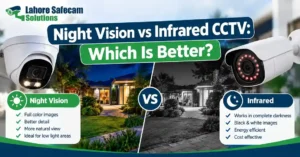
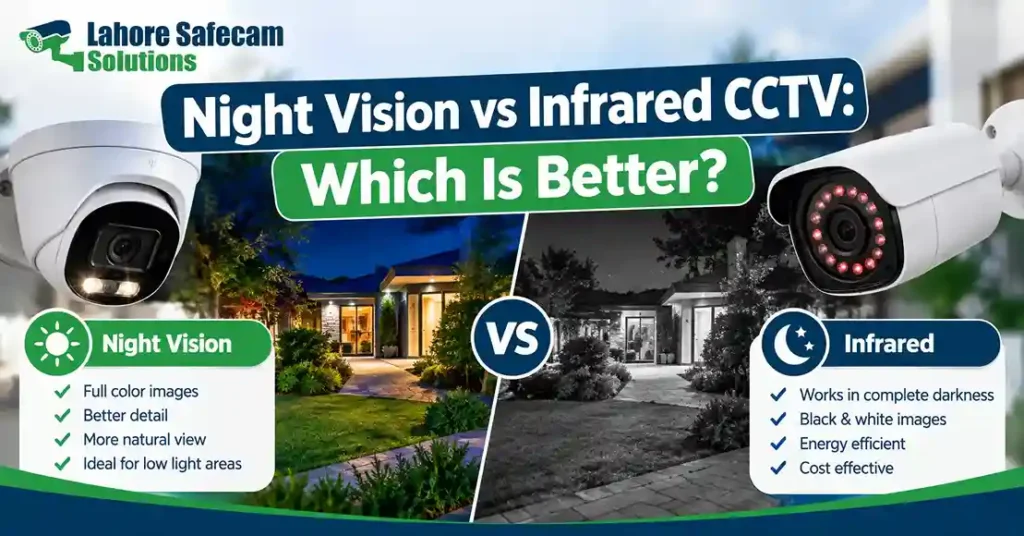
The simplest difference is the type of nighttime image each technology is designed to produce. Traditional infrared CCTV uses IR illumination to help a compatible camera record when visible light becomes very low. Day-and-night cameras commonly switch from normal daytime colour imaging to grayscale night footage as ambient light falls. Infrared illumination can also allow surveillance in complete darkness. A full colour night vision camera, by comparison, is designed to preserve colour information for longer in low-light conditions. Depending on the camera, this may rely on a more light-sensitive sensor, a larger aperture, image processing, visible supplementary lighting, or a combination of these technologies. That difference matters because colour can provide additional context when footage is reviewed.
Is Colour Footage More Useful at Night?
Sometimes, yes. Imagine reviewing footage of a person standing near a gate. Infrared CCTV may clearly show: their height, movement, direction, and general appearance. Colour night vision may add: shirt colour, vehicle colour, bag colour, or other visual distinctions. Colour information can therefore be useful when identification depends on more than shape. Low-light camera technologies are specifically designed to retain colour information under conditions where conventional cameras might otherwise move into grayscale night mode. However, useful colour footage still depends on camera quality and lighting conditions. A poor-quality colour image with heavy noise or motion blur is not automatically better evidence than a sharp infrared recording. The goal should always be usable detail, not colour for its own sake.
Where Infrared CCTV Has a Clear Advantage
Infrared remains extremely useful because it can operate when visible light is extremely limited or absent. That makes an IR CCTV camera particularly suitable for locations that may become genuinely dark after closing time. Examples could include: a side passage with no permanent light, a dark rear entrance, a storage area, a boundary section, or another position where you do not want visible lighting operating throughout the night. Infrared LEDs illuminate the scene with near-infrared light that the camera sensor can detect. The resulting night image is usually grayscale rather than natural colour. The practical benefit is straightforward. You can monitor an area without needing to keep a bright visible light switched on simply for the camera.
Where Colour Night Vision Becomes More Attractive
Colour night vision is particularly interesting where identifying colour adds meaningful information. Consider a camera overlooking a Lahore home’s front gate or driveway. If the area already receives some illumination from gate lights, exterior lighting, or nearby sources, a suitable low-light CCTV camera may be able to preserve useful colour detail. The same principle can apply to: shop entrances, parking spaces, office entrances and other areas where identifying people or vehicles may matter. Modern systems also blur the old distinction between colour and infrared. Hikvision, for example, offers Smart Hybrid Light models combining IR and white light with multiple supplemental lighting modes. Some models also combine this with ColorVu technology. That means the decision is no longer always “colour or IR.” Some cameras can change lighting behaviour according to conditions or configuration.
Does Colour Night Vision Work in Complete Darkness?
This is where buyers need to read specifications carefully. “Colour night vision” does not mean every camera can naturally produce detailed colour footage with absolutely no light. Colour imaging requires usable light information. Different camera systems obtain that light in different ways. Some use highly sensitive sensors and wide apertures to work with very low ambient light. Others use supplementary white light when necessary. Hikvision’s current ColorVu and Smart Hybrid Light product specifications, for example, include cameras offering colour imaging at very low illumination levels while also incorporating white light or combined IR and white-light modes. So when buying a colour night vision CCTV camera, do not rely only on the marketing phrase. Check how the particular model creates colour footage.
What About Infrared in Total Darkness?
Infrared is well suited to this situation. IR-equipped surveillance cameras can use built-in infrared illumination to monitor scenes even when visible light is absent. Current surveillance cameras from multiple manufacturers continue to use IR specifically for low-light and complete-darkness monitoring. That makes conventional IR a strong option for locations where there is no street lighting, visible white light would be distracting, or constant colour information is not essential. This is why traditional infrared CCTV has not become obsolete simply because full-colour systems exist. Each solves a different problem.
Night Vision Comparison at a Glance
| Feature | Colour Night Vision | Infrared CCTV |
| Night image | Colour where conditions support it | Usually grayscale |
| Visible lighting | May require or use white light | Generally not required |
| Complete darkness | Depends on model and illumination | Strong use case |
| Colour identification | Better potential | Limited |
| Discreet operation | Depends on supplementary lighting | Often better |
| Gates and driveways | Strong option | Also suitable |
| Dark passages | Depends on available light | Often practical |
| Clothing/vehicle colour | Potentially retained | Usually lost in IR mode |
Neither side wins every category.
The correct choice depends on what information you need the camera to capture.
Which Is Better for a Main Gate in Lahore?
For a main gate, colour night vision can be attractive because colour information may help distinguish people, clothing, and vehicles. But camera positioning matters just as much. If a bright light shines directly into the lens, even an expensive night vision security camera can struggle to produce useful footage. The camera should also be positioned so that people approaching the gate are recorded at a useful angle rather than only from above. If your gate already has suitable lighting, a colour-focused low-light camera may make sense. If the area becomes completely dark and you do not want visible supplementary illumination, infrared may be more practical.
What About Driveways and Parking Areas?
Driveways present a different challenge because vehicles move and headlights create strong contrast. Here, resolution alone should not determine the decision. Consider: the distance between the camera and vehicles, viewing angle, available lighting, and whether identifying vehicle colour matters. A full colour night vision camera may provide valuable context where lighting allows good colour capture. Infrared can still provide reliable general surveillance where the priority is detecting movement and recording activity in darkness. For a driveway, ask an installer to consider the actual scene rather than recommending a camera solely from a brochure specification.
Which Technology Works Better for Shops?
A shop often has more predictable lighting than an outdoor residential boundary. If exterior or entrance lighting remains available, colour footage can be useful around entry points. Inside a shop, the bigger question may not even be night vision. Camera placement, counter coverage, storage areas and recording quality could matter more. After closing, however, lights may be switched off completely. That is where IR or hybrid illumination can become useful. A Lahore shop owner should therefore think about both operating hours and after-hours conditions before deciding on the camera technology.
Can Infrared Cause Glare or Reflection?
Yes, installation position can affect IR performance. Infrared light can reflect from nearby surfaces and reduce image quality. For example, positioning a camera too close to a wall, ceiling edge, or reflective surface may send some of the IR illumination back toward the lens. Dust, moisture, or dirt around a camera cover can also interfere with nighttime footage. This means a problem that appears to be “bad night vision” may actually be an installation issue. Before replacing an infrared camera, check: camera angle, surrounding surfaces, lens cleanliness, and nearby reflective objects.
Does a Higher Megapixel Camera Automatically Have Better Night Vision?
No. A 4MP or 8MP label tells you about image resolution, not the complete low-light performance of the camera. Night footage is influenced by several factors, including sensor characteristics, aperture, illumination, exposure settings, image processing, and the amount of available light. For example, Hikvision currently sells Smart Hybrid Light cameras across multiple resolutions, including 2MP, 4MP, and 8MP products. This illustrates why illumination technology and resolution should be considered separately. When comparing cameras, look beyond the megapixel number.
What Should You Ask Before Buying a Night Vision CCTV Camera?
Instead of starting with “Which camera is best?”, start with the location.
Ask yourself:
Will this area have any light at night?
Do I need to identify colours?
Would visible white illumination disturb anyone?
How far is the subject from the camera?
Is the area indoors or outdoors?
Do I need general monitoring or detailed identification?
These questions make the buying decision much easier. A professional CCTV installer in Lahore should also inspect the scene before recommending a night surveillance camera, particularly for important gates, parking areas, and darker exterior positions.
Can One CCTV System Use Both Technologies?
Yes, and for many properties, that may be the more sensible approach. There is no rule saying every camera around a property must use identical night technology. A system might use colour-focused cameras at important entrances while relying on infrared in darker, lower-priority areas. Hybrid-light cameras provide another option by combining different illumination modes in a single camera. This allows the CCTV design to follow the security requirement of each position rather than forcing one technology across the entire property.
So, Which One Should You Choose?
Choose infrared CCTV when the area becomes very dark, discreet nighttime monitoring is important, and retaining colour information is not essential. Consider colour night vision CCTV when colour details could help identify people, clothing, objects, or vehicles and the camera has suitable low-light capability or supplementary illumination. Consider hybrid-light technology when you want more flexibility between IR and visible illumination. For Lahore homeowners and businesses, the best choice often varies from one camera location to another. The gate, driveway, side passage, and indoor areas do not necessarily need the same technology.
Final Verdict
There is no universal winner in the colour night vision vs infrared CCTV comparison. Infrared remains a practical and proven way to monitor locations with little or no visible light. Colour night vision offers an advantage when retaining colour information can make recorded footage more useful. What matters is matching the camera to the scene. Before arranging Expert CCTV installation in Lahore, check the lighting conditions after dark rather than choosing every camera during daylight. Decide where colour information actually matters, identify areas that become completely dark, and then select the appropriate technology for each position. A CCTV system designed around real nighttime conditions will usually provide more useful surveillance than one chosen simply because a particular camera has the newest feature.
FAQs: Colour Night Vision vs Infrared CCTV
What is the difference between colour night vision and infrared CCTV?
Colour night vision CCTV is designed to retain colour details in low-light conditions, while infrared CCTV usually switches to black-and-white footage at night using IR illumination. The better option depends on lighting conditions and the type of detail you need.
Is colour night vision better than infrared CCTV?
Colour night vision can be better when identifying clothing, vehicles, or other colour details is important. Infrared CCTV can be more practical in very dark areas where visible lighting is limited or unavailable.
Can infrared CCTV cameras record in complete darkness?
Yes. Many infrared CCTV cameras use built-in IR LEDs to illuminate an area without visible light. This allows them to record in very dark conditions, although the footage is normally black and white.
Does colour night vision CCTV need light to work?
Colour night vision cameras generally need some usable light or supplementary white illumination to maintain colour footage. How much light is required depends on the camera sensor, aperture, and low-light technology.
Which is better for a Lahore home, colour night vision or infrared CCTV?
For gates, driveways, and entrances where colour identification matters, colour night vision may be useful. Infrared CCTV can be better for darker passages, rear areas or locations where discreet night monitoring is more important.