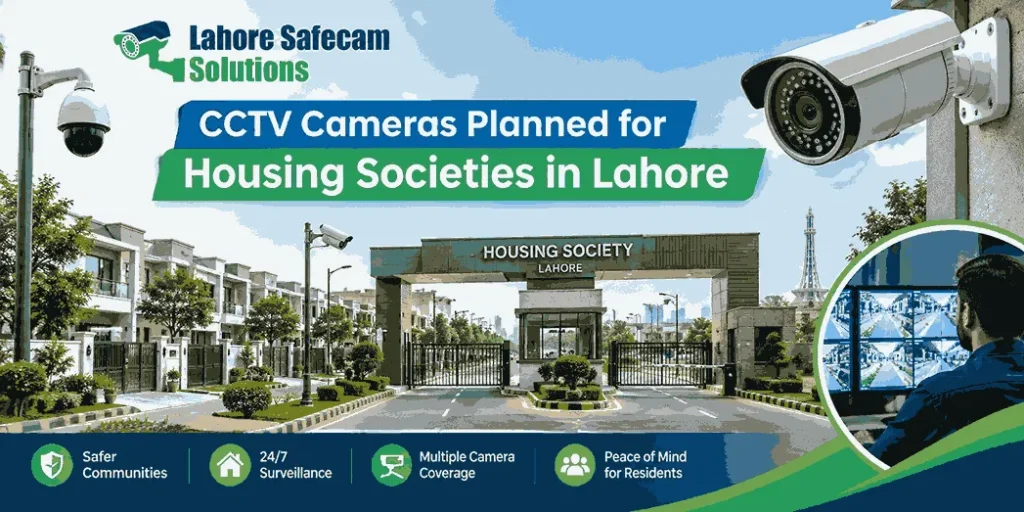
A housing society can have dozens of CCTV cameras and still struggle to answer one basic question: which vehicle entered, where did it go, and when did it leave? That happens when cameras are installed as separate devices instead of being planned as one security network. Effective CCTV for housing societies in Lahore should connect three things: controlled entry at society gates, visibility across important community areas, and a monitoring system that helps security staff respond when something unusual happens. Number plate capture, visitor management, internal-road coverage, perimeter surveillance, and a properly managed control room are often more useful than simply increasing the camera count. For large residential communities, CCTV should support the way the society actually operates.
Think Beyond Cameras at the Main Gate
The main gate is important, but a housing society does not stop at its entrance. Once a vehicle passes through the gate, it may travel along internal roads, enter a commercial area, stop near a park, visit a residence or leave through another exit. A useful surveillance plan should therefore create a sequence of coverage. Think of it as a chain:
Gate → vehicle identification → internal movement → shared areas → exit → incident review.
When those stages connect, security staff have a better chance of reconstructing what happened. This is particularly relevant in Lahore. On 12 May 2026, Daily Pakistan reported that Lahore police ordered fresh security audits of housing societies, with a focus on improved CCTV coverage and monitoring, screening at entry and exit points, trained guards, and resident and visitor records. That reinforces an important point: society security is not just about owning cameras. Monitoring and access procedures matter too.
Layer One: Make the Gate Produce Useful Information
A housing society gate handles several different categories of traffic. Residents may use one lane. Visitors may use another. Delivery riders, contractors, domestic staff, and service vehicles may follow different entry procedures. One camera looking down at the entire gate may show traffic moving through, but it may not provide the detail security staff need later.
Resident and Visitor Lanes Need Different Thinking
If resident vehicles pass quickly through a dedicated lane, the surveillance requirement may focus on vehicle identification and entry timing. A visitor lane has a different purpose. Security staff may need to verify who is entering, record vehicle details and connect the visit with a particular destination. That makes visitor management part of CCTV planning rather than a separate issue. A camera covering the checkpoint can provide visual evidence, while the gate procedure records who was permitted to enter. The strongest setup is one where those two systems support each other.
Should Housing Societies Use Number Plate Cameras?
For busy gates, ordinary wide-angle CCTV may not always capture a number plate clearly enough to read. An ANPR camera, or automatic number plate recognition camera, is designed specifically around vehicle plates. Whether a society needs ANPR depends on traffic volume, gate design, lighting, viewing distance and how vehicle records are managed. It should not be assumed that adding ANPR automatically solves gate security. Camera angle is critical. A plate viewed from too steep an angle, blocked by another vehicle or washed out by headlights may still be difficult to identify. For societies that want reliable number plate capture, the installation should be tested with actual cars entering and leaving during both daylight and night conditions.
Layer Two: Create a Movement Map Inside the Society
After the gate, CCTV planning changes. Trying to cover every metre of every street would often require an unnecessarily large system. A more useful approach is to identify locations where movement naturally converges. These may include:
- major intersections
- sector entrances
- roundabouts
- commercial zones
- community facilities
- parking areas
- important connecting roads
These points create a visual map of movement through the society. For example, if a vehicle is recorded entering at Gate A and later appears at a major internal intersection, security staff gain more information than they would from an isolated gate recording. This is the difference between community surveillance and a collection of unrelated cameras.
Shared Spaces Need Their Own Security Logic
Housing societies include more than houses and roads. There may be parks, playgrounds, mosques, community centres, commercial areas and other shared spaces used by residents throughout the day. Each area should be considered according to its actual purpose. A park does not necessarily need cameras focused closely on people sitting there. Coverage may instead be more useful around entrances, pathways or adjoining parking areas. A commercial zone may require stronger coverage of vehicle movement and common access routes. A playground may benefit from general-area visibility rather than intrusive close surveillance.
The question should always be:
What would security staff need to understand if an incident were reported here?
That question usually produces better camera placement than trying to eliminate every square metre of unseen space.
Layer Three: Treat the Society Boundary Differently From Internal Roads
A boundary wall creates another surveillance problem. Installing cameras at fixed intervals without considering the surrounding environment can produce large amounts of repetitive footage while still leaving important areas weakly covered. Instead, assess the perimeter for:
accessible points, blind corners, service access, low-visibility stretches and places where nearby structures affect the boundary.
The objective is not necessarily to make every section of wall look identical on a monitoring screen. It is to identify sections where unauthorised entry would be harder for guards or patrol teams to notice. PTZ cameras may help observe wider outdoor spaces in some situations, while fixed cameras can maintain continuous views of specific vulnerable points. The correct balance depends on the size and layout of the community.
The Control Room Is Where Separate Cameras Become One System
A large society can install excellent cameras and still get limited value from them if nobody knows what to watch. The security control room changes that. DHA Lahore describes its security operation as using a CCTV and Emergency Control Centre for real-time monitoring alongside patrol teams and reinforced entry and exit checks. This is a useful example of CCTV being integrated into wider security operations rather than treated as a standalone technology. A security control room should make it easy for operators to locate relevant cameras quickly.
Camera names such as:
- Camera 01
- Camera 02
- Camera 03
are not particularly useful during an incident.
Names such as:
- Main Gate Visitor Entry
- Sector C Junction
- Commercial Parking North
- Park 2 Entrance
That small organisational detail can matter when footage needs to be found quickly.
CCTV Should Support Guards, Not Replace Them
A camera can show that something happened. It cannot physically stop a vehicle, check a visitor’s identification or walk to an area where suspicious activity has been reported. That is why central monitoring works best when connected with security guards and patrol teams. Imagine a control-room operator sees a vehicle stop near a restricted service area late at night. The useful response is not simply to continue recording. The operator should have a defined way to contact the relevant patrol or gate staff and communicate the camera location. This creates a simple security cycle: Detect → verify → communicate → respond → review Without that operational connection, even high-quality CCTV can become mostly an archive of incidents that have already happened.
Access Control Can Strengthen Gate Security
Not every access problem needs another camera. A society may also use boom barriers, resident identification, visitor registration or other access-control methods. CCTV provides the visual record. Access control helps determine who should be allowed through. These technologies solve different parts of the same problem. Lahore Safecam Solutions explains this distinction further in its guide to security products for homes and offices in Lahore, which compares CCTV with alarms, access control and biometric systems. For a housing society, combining the right tools can be more effective than expecting surveillance cameras to perform every security function.
Do Not Forget Camera Quality Checks
Society CCTV usually includes outdoor cameras exposed to changing light, traffic, weather and dust. This means installation quality needs regular review. A camera may still appear online in the control room while its image has become less useful because of:
- dirt on the lens
- tree growth blocking part of the frame
- changed street lighting
- a shifted camera angle
- poor night visibility
- newly created blind spots
Periodic testing should include real footage rather than only checking whether the camera status says “online”. Your team can use the CCTV installation quality checklist as a practical reference when reviewing image quality, camera angles, and blind spots.
Lahore Has Already Moved Towards Connected Society Surveillance
Housing-society CCTV in Lahore is not developing in isolation. In February 2022, the Punjab government announced a plan to integrate cameras from LDA-approved private housing societies with the Punjab Safe Cities Authority surveillance system. According to the Punjab government, routine monitoring, ownership and maintenance would remain the responsibility of each housing society, while integration could support law-enforcement investigation and crime tracing. For society management, that highlights the importance of maintaining organised, functional systems rather than treating CCTV as equipment that is installed once and then forgotten.
How will guards respond to what operators detect?
Once those questions are answered, camera quantity becomes much easier to calculate. That is the core of planning CCTV for housing societies in Lahore. A useful surveillance system should create continuity from the gate to the control room and from the control room to the security team. It should help the society understand movement, verify incidents, and respond more effectively, rather than simply producing more screens to watch.
Planning CCTV for a Housing Society in Lahore?
Lahore Safecam Solutions can assess society gates, vehicle lanes, internal roads, common areas, perimeter points, and monitoring requirements before recommending a surveillance layout. Instead of beginning with a camera package, the planning process can begin with your society’s actual access routes and security operations. Contact Lahore Safecam Solutions to discuss CCTV planning for a residential society in Lahore.
Asked Questions: CCTV for Housing Societies in Lahore
Where should CCTV cameras be placed in a housing society?
Priority locations can include entry and exit gates, major internal junctions, sector entrances, commercial areas, shared facilities, parking zones, and selected perimeter points. Final placement should reflect the society’s layout and security procedures.
Should housing society gates use ANPR cameras?
ANPR can be useful where a society needs reliable number plate identification. Whether it is appropriate depends on gate layout, traffic volume, lighting, and how vehicle information will be used.
What is the purpose of a CCTV control room?
A control room brings camera feeds together so authorised operators can monitor important locations, review incidents and communicate relevant information to security staff or patrol teams.
Can CCTV be integrated with a boom barrier?
Depending on the equipment being used, CCTV, ANPR and access-control systems can be designed to work alongside boom barriers. The exact configuration depends on the gate-management system.
Should parks inside housing societies have CCTV?
Some shared spaces may benefit from CCTV, particularly around entrances, paths or nearby parking. Coverage should have a defined security purpose rather than focusing unnecessarily on individual residents.
How can CCTV support society security guards?
Operators can use camera feeds to verify activity and direct guards or patrol teams towards a relevant location. CCTV provides visibility, while guards provide the physical response.
Who should be allowed to view housing society CCTV?
Access should be limited to authorised personnel according to the society’s security procedures. Administrative permissions and footage export rights should not be shared more widely than necessary.