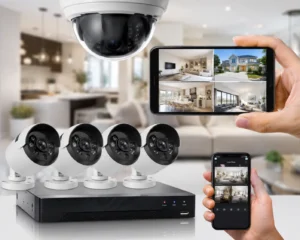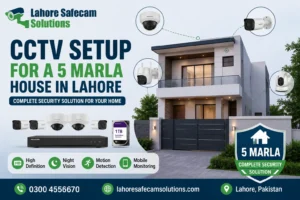
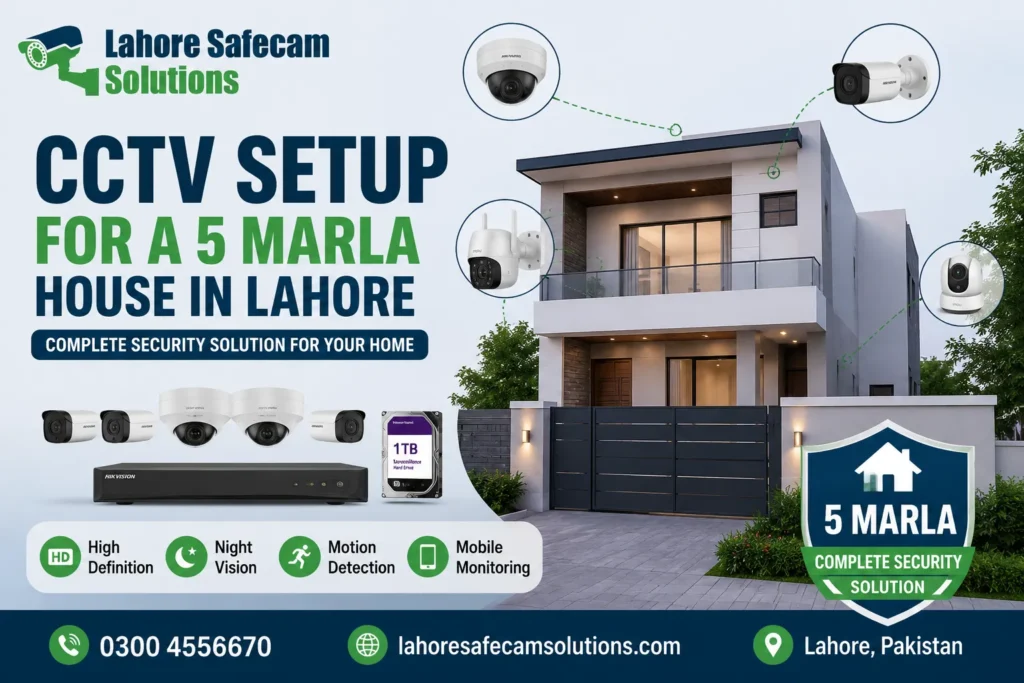
For most 5 Marla homes, around four to six CCTV cameras can provide useful coverage, but the right number depends on the house rather than the plot size alone. A single-storey property with one gate may need fewer cameras than a double-storey house with side access, rooftop entry, or several vulnerable areas. The goal is not to install as many cameras as possible. It is to cover the places where people can enter, leave or approach the property without creating unnecessary blind spots.
For homeowners in Lahore, camera placement also needs to account for street-facing gates, car porches, narrow side passages, outdoor heat, dust, and electricity interruptions. A well-planned CCTV setup for a 5 Marla house can often achieve better coverage with fewer correctly positioned cameras than a larger system installed without a clear plan.
Start With the Areas You Actually Need to See
Before deciding how many CCTV cameras for a 5 Marla house are required, walk around the property as though you were approaching it for the first time. Look at the main gate, front entrance, car porch, side passages, rear access, staircase and rooftop. These are usually more important than simply placing one camera in every room or on every wall.
Ask what you need each camera to capture. Monitoring general movement outside the house requires a different position from identifying someone approaching the front door. A camera watching a gate should provide a useful view of visitors and vehicles, while another may be needed to cover an area hidden from that first camera.
Is a Four-Camera CCTV System Enough?
For a straightforward 5 Marla property, four cameras may be enough when the layout has limited access points. A common arrangement could include one camera covering the main gate, one overlooking the porch or parking area, another monitoring the main entrance and a fourth protecting a rear or side access point.
That does not make a four-camera CCTV system suitable for every house. If the gate camera already covers the entire porch clearly, using another camera in almost the same position may add little value. On the other hand, a narrow passage beside the house or an accessible rear entrance could justify an additional camera even in a relatively small property. The correct number comes from coverage, not from matching a standard package.
Where Should the First Camera Go?
For many Lahore homes, the main gate deserves the highest priority because it is the point through which residents, visitors, deliveries and vehicles usually enter. The camera should be positioned so that the gate structure, lighting or nearby walls do not block the important part of the view. Mounting a camera too high may show the top of a person’s head rather than useful facial detail, while placing it too low can make it easier to interfere with. A good gate camera position should balance identification, general surveillance and protection of the camera itself. The exact field of view will depend on the entrance width, camera lens and distance from the area being monitored.
Do You Need a Separate Camera for the Car Porch?
A camera watching the main gate does not always provide good coverage of a vehicle parked inside the property. The gate may be visible while part of the car porch remains outside the camera’s viewing angle. For houses with a car parking area, a separate camera can be useful when you want to monitor vehicles, the porch entrance and activity close to the front of the house. A wide-angle camera may cover a compact area effectively, but the position should still provide enough detail rather than simply showing the entire space from too far away. This is why camera coverage should be checked physically before drilling and cabling begin.
Do Side Passages Need CCTV Coverage?
Side passages are easy to overlook because they may be narrow or rarely used. From a security perspective, that can make them worth checking. A 5 Marla property built close to neighbouring houses may have little side access, while another house may include a passage leading towards the rear, stairs or utility area. If someone can move through that space without appearing on the gate or porch camera, it represents a potential CCTV blind spot. In this situation, a fifth camera can be more valuable than adding another camera to an already well-covered front elevation.
What About the Rear of the House?
Rear doors, service entrances and accessible windows should be considered during the CCTV installation plan. They do not automatically require their own camera, but they should not be ignored simply because most activity happens at the front of the house. A rear camera becomes more useful where the property backs onto an open area, lane, neighbouring access route or space that can be approached without passing the main entrance. The position should cover the vulnerable route rather than point at an area that residents rarely use and nobody can realistically access. Good surveillance starts with risk, not symmetry.
How Many Cameras Does a Double-Storey 5 Marla House Need?
A double-storey house may need more coverage than a single-storey property because there can be additional staircases, balconies, terraces and rooftop access points. For this type of property, five or six cameras may be more practical depending on the design. For example, four cameras could cover the ground-level perimeter while another watches stair or rooftop access. A sixth may be useful if the rear or side of the house remains outside the other cameras’ fields of view. The number should increase only when an additional camera covers a genuine security gap.
Should You Install CCTV Cameras Inside the House?
Indoor cameras are not necessary for every household. Many homeowners are mainly interested in external security, including the gate, entrance, parking area and perimeter. Indoor CCTV can be considered for shared access areas, an internal staircase, entrance lobby or another space where monitoring has a clear purpose. Privacy should also be considered carefully. Cameras should not be placed in bedrooms, bathrooms or other areas where people reasonably expect privacy. For most residential systems, securing entry points first is a better starting point than filling the house with cameras.
How Can You Avoid CCTV Blind Spots?
The easiest way to create blind spots is to choose camera positions based on appearance rather than actual coverage. Before installation, imagine someone walking around the entire property. Could they reach a door, staircase or rear area without appearing clearly on any camera? Could a wall, pillar, tree, gate or parked vehicle block the view? Does one camera duplicate another while a separate area remains unseen? Some overlap between cameras can be helpful, especially around important entrances, but excessive overlap wastes coverage. The aim is to create connected surveillance zones around the property rather than several cameras looking at almost the same place.
Which CCTV Camera Type Works Well for a 5 Marla Home?
There is no single camera type that suits every position. Bullet cameras are commonly used outdoors because their shape can work well for focused views along gates, walls and passages. Turret and dome-style cameras can be useful where a more compact design or wider viewing area is preferred. IP CCTV cameras, analogue cameras, wired systems and wireless CCTV cameras can all be considered depending on the property and installation requirements. Resolution should also match the job. A 2MP camera may be adequate for general monitoring in some areas, while 4MP or 5MP CCTV cameras may be preferred where greater detail is needed. Higher resolution should not replace proper positioning, lighting and lens selection.
Night-Time Coverage Matters Just as Much
A camera position that looks perfect during the day may perform differently after dark. Outdoor lighting, vehicle headlights, reflective surfaces and infrared illumination can affect night footage. A night vision camera should therefore be tested under the conditions in which it will actually operate. Installing a camera directly beside a bright light or reflective wall can sometimes reduce useful image detail rather than improve it. For Lahore homeowners, the better approach is to plan daytime and night-time coverage together instead of assuming every camera with infrared will automatically provide a clear night image.
Should You Choose a DVR or NVR?
The recorder should support the type and number of cameras planned for the property. A DVR is commonly used with analogue CCTV cameras, while an NVR is generally paired with IP cameras. If you expect the system to expand later, avoid selecting a recorder that leaves no spare channels. A four-camera installation connected to a four-channel recorder can create an unnecessary upgrade if you later decide that a fifth camera is needed. For a flexible home CCTV system in Lahore, planning channel capacity before installation can save both rewiring and equipment replacement later.
How Much CCTV Storage Will the House Need?
Camera count directly affects storage because every additional camera creates more footage. A system recording four cameras will usually require less storage than one recording six cameras under the same settings. Resolution, frame rate, video compression and whether the cameras record continuously or on motion also influence how quickly a surveillance hard drive fills. Instead of choosing a hard drive by capacity alone, decide how many days of footage you want available. Your CCTV recorder and storage can then be sized around the number of cameras and actual retention requirement.
Plan for Load Shedding and Power Interruptions
A CCTV system cannot provide continuous recording if important equipment loses power. For Lahore properties, power backup should therefore form part of the installation plan. Depending on the system, a UPS may need to support the DVR or NVR, cameras, PoE switch, router or camera power supply. Remote viewing may also stop if the router loses electricity even when local recording continues. The backup requirement should be calculated around the complete surveillance system rather than connecting equipment to a small UPS and assuming it will run for a particular length of time.
So, How Many CCTV Cameras Does Your 5 Marla House Need?
For many properties, four to six CCTV cameras for a 5 Marla house can be a sensible starting range. A simple home with one entrance and limited side access may achieve good coverage with four carefully positioned cameras. A double-storey property with a rear entrance, side passage, terrace or rooftop access may need five or six. Some houses may require fewer, while unusual layouts could require more.
The final count should come from three questions:
- Which areas can someone use to approach or enter the property?
- Which of those areas are already visible from another camera?
- Is the footage detailed enough to be useful, not just present?
Answering those questions is more reliable than buying a CCTV package based only on the size of the plot.
Frequently Asked Questions
Are four CCTV cameras enough for a 5 Marla house?
Four cameras can be enough for a simple 5 Marla house where the main gate, entrance, porch and secondary access area can all be covered properly. Houses with additional blind spots or rooftop access may need more.
Where should CCTV cameras be installed in a 5 Marla house?
Priority areas usually include the main gate, front entrance, car porch and any side or rear access. Staircases or rooftop entrances may also need coverage depending on the property’s layout.
Does a rooftop need a CCTV camera?
Not always. A rooftop camera may be useful when the roof can be reached from neighbouring buildings, external stairs or another accessible route. If rooftop access is already controlled and covered, an additional camera may not be necessary.
Is 2MP CCTV enough for home security?
A 2MP camera can provide useful general surveillance, but the appropriate resolution depends on viewing distance and the level of detail needed. Some locations may benefit from 4MP, 5MP or higher-resolution cameras.
Can CCTV cameras work during load shedding?
They can continue operating when the cameras, recorder and necessary network equipment are connected to suitable backup power. The required UPS capacity depends on the equipment and desired backup duration.
Is an 8-channel recorder suitable for a 5 Marla house?
It can be a practical option when you currently need four to six cameras but may expand later. Recorder compatibility, supported resolution, bandwidth and storage requirements should also be checked.