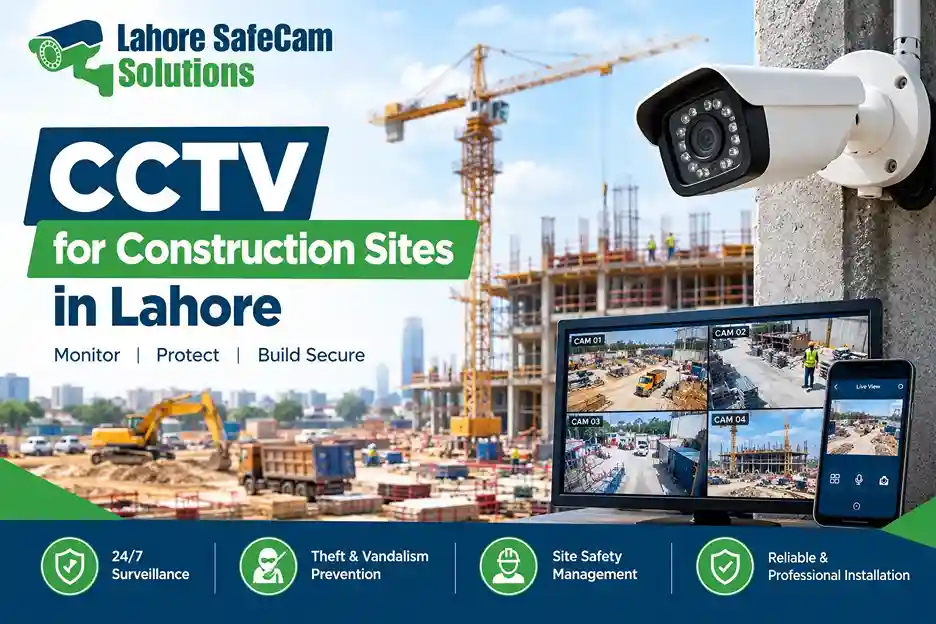
A construction site rarely looks the same for long. An open plot becomes a foundation, scaffolding appears, materials move, walls block old camera views, and an entrance used this month may shift when the next stage begins. That is why CCTV for construction sites in Lahore needs a different approach from CCTV installed in a finished home or office. A practical setup should monitor site entrances, stored materials, machinery, and vulnerable perimeter areas while remaining flexible enough to change as construction progresses. Where permanent electricity or internet is unavailable, temporary 4G or solar-powered cameras can provide another option. The important point is simple: the CCTV plan should move with the project.
Phase One: Secure the Site Before the Building Exists
Early construction can be one of the most awkward stages for surveillance. There may be little more than a boundary, temporary gate, site office, and piles of materials. Permanent cabling may not exist, and electricity may still be temporary. At this stage, trying to design the final CCTV system is often premature. Instead, identify the places where activity is concentrated.
Give the Site Entrance a Clear View
The main gate is usually the first useful monitoring point. Workers arrive through it. Contractors enter. Deliveries come and go. Vehicles carrying materials use the same access point. A camera covering the site entrance should therefore provide enough detail to review who or what entered the property, rather than simply showing general movement from a distance. The position also needs to account for vehicle headlights at night and strong daylight during the day. A poorly chosen angle can make a good camera produce weak footage. Where there are separate entry and exit gates, each route should be assessed independently.
Watch Where Materials Actually Stay
Bricks, steel, electrical equipment, sanitary fittings, and other materials may be stored in different areas as work progresses. This is where material storage monitoring becomes more useful than installing cameras randomly around the boundary. One Pakistani example comes from a National Highway Authority project security document. Its construction-site specification calls for CCTV at entrance gates, storage areas, working areas, access roads, and parking, alongside backup power and recording retention requirements. These are requirements for that particular NHA project, not a universal legal standard for every private Lahore construction site, but they provide a useful real-world example of risk-based camera placement. For a private project, the same principle applies: identify the places containing something worth monitoring.
Phase Two: The Site Grows, and Your Blind Spots Move
A camera position that works perfectly during excavation may become almost useless once walls, columns or scaffolding appear. This is where construction CCTV differs most from a permanent installation. Imagine a camera originally covering the gate and most of an open plot. Six weeks later, a newly built wall blocks half of its view. The camera is still recording, but the useful coverage has disappeared. Construction sites therefore need periodic camera reviews. A useful question every few weeks is:
Can each camera still see the area it was installed to protect?
If the answer is no, the camera may need to move.
Temporary Mounting Can Be an Advantage
Not every camera needs to be permanently drilled into finished masonry during the early stages. Depending on the equipment, temporary mounting on suitable poles, secure structures or other stable positions can make cameras easier to reposition as the project changes. The mounting itself must still be secure. A temporary setup should not mean a camera that can easily be knocked, removed, or pointed in another direction. Cable routes also need protection from construction activity. Exposed cables running across active work areas can be damaged by tools, vehicles, and ongoing building work.
Fixed Cameras or PTZ Cameras?
Large construction areas can require different viewing methods. A fixed bullet camera may work well when one important location must remain continuously visible, such as a gate, material yard or site-office entrance. A PTZ camera can provide pan, tilt, and zoom capability across a wider outdoor area. That can be useful for checking different parts of a site remotely. But a PTZ should not automatically replace several fixed cameras. If the PTZ is facing one direction, an event occurring behind it may not be captured unless another camera covers that area. For critical zones, continuous fixed coverage can still be important. The camera should match the task rather than being selected simply because it has more features.
What If the Site Has No WiFi or Permanent Electricity?
This is one of the most important differences between construction site CCTV in Lahore and surveillance in an occupied building.
A new construction project may have:
- no broadband connection
- temporary electrical supply
- no finished network cabling
- changing camera positions
- remote sections far from the site office
A conventional wired system can still work where suitable infrastructure exists, but it is not always the only solution.
4G CCTV Can Cover Remote Parts of the Site
A 4G CCTV camera uses a mobile data connection rather than depending on the property’s fixed broadband. That can make it useful for temporary or remote monitoring where mobile network coverage is available. Current products sold in Pakistan include 4G LTE cameras specifically promoted for construction-site monitoring, with applications such as viewing machinery, building materials, and remote site areas. Some combine 4G connectivity with solar charging and battery power. This does not mean solar 4G is automatically right for every construction project. Signal strength, data requirements, charging conditions, recording method, and camera location still need checking. But it solves an important problem: surveillance does not necessarily have to wait until the building has permanent internet and electrical infrastructure.
Night-Time Coverage Needs Its Own Test
Construction activity may stop in the evening, but the security requirement does not. A daytime image can look excellent while the same camera produces poor footage after dark.
the entrance, material storage, machinery, site office, parking and accessible sections of the perimeter.
Do not judge night vision from the camera specification alone. Dust, glare, reflective surfaces and nearby lighting can affect what the image actually looks like. For example, infrared light reflecting from a nearby wall, scaffolding sheet or dusty camera cover can wash out part of the image. The better test is practical: walk through the monitored area after dark and then review the recording.
Protect Machinery and Equipment Without Trying to Watch Everything
Large construction sites can contain generators, tools, plant and machinery spread across different areas. Trying to achieve identical surveillance coverage across the entire project can quickly become inefficient. Prioritise locations according to value and access. A machinery area used only by authorised workers may need a clear view of its approach. A generator or equipment compound may need coverage of both the asset and the route used to reach it. That gives the footage context. A close view of a machine is less useful if the recording does not show how someone reached it. This is where camera placement matters more than camera quantity.
Remote Monitoring Can Help When Nobody Is On Site
Construction projects often involve owners, contractors and project managers who are not physically present throughout the day. A properly configured remote monitoring system can allow an authorised person to check selected cameras from a phone or computer.
That can be particularly useful for confirming:
- whether a delivery has arrived
- whether the site gate is open or closed
- activity outside normal working hours
- the condition of material areas
- movement around machinery
- whether a particular section remains accessible
Remote viewing should still be secured properly. Default passwords should be changed, unnecessary accounts should not be created, and access should be removed when a contractor or staff member no longer requires it. A security camera should not create an unnecessary cybersecurity weakness.
Recording Needs Change as the Camera Count Grows
Early in the project, temporary cameras may record locally or through their own supported storage method. As construction advances, the site may move towards a more conventional DVR or NVR setup with multiple cameras and a surveillance hard drive. At that point, recording capacity becomes important. Storage depends on factors such as resolution, bitrate, number of cameras, recording schedule, and required retention period. The NHA project specification mentioned earlier requires at least 30 days of CCTV recording for that particular project. That should not be copied automatically as a rule for every private construction site. Instead, decide how far back you realistically need to review an incident, delivery, or access event, then size the storage accordingly.
Do Not Let a Power Cut Create the Missing Hour
A CCTV recorder staying switched on does not guarantee the cameras are still recording. A wired system may rely on camera power supplies, a PoE switch, an NVR, and other network equipment. If one essential part of that chain loses electricity, recording can stop. For Lahore projects using temporary or permanent electrical supply, backup power should therefore be planned around the equipment that actually keeps video flowing. Lahore Safecam Solutions has a separate guide explaining how cameras, recorders and PoE equipment interact during outages.
Phase Three: Move From Temporary CCTV to the Final System
As construction reaches the finishing stage, CCTV planning changes again. Windows and doors are installed. Permanent electrical circuits become available. Network cabling may be ready. Parking spaces and access routes settle into their final positions. This is the right time to reconsider which temporary cameras should remain and which areas require permanent surveillance. The final system might use existing temporary equipment in some locations, but it should not simply inherit every camera position from the construction phase. The risks have changed. A pile of building materials may have disappeared, while the finished gate, parking area, lobby, or boundary has become more important. Treat the final CCTV installation as a new security plan rather than the last stage of the temporary one.
A Construction CCTV Plan Should Never Stay Frozen
The best CCTV for construction sites in Lahore is not necessarily the system with the highest camera count. It is the system that continues to cover important areas as the site develops. During early work, that may mean temporary surveillance of gates, materials, and machinery. During structural work, cameras may need repositioning as walls create new blind spots. Where utilities are unavailable, 4G or solar-powered CCTV may provide temporary monitoring. Near completion, the site can transition towards a permanent wired system designed around the finished property. The construction changes. Your CCTV plan should change with it.
Need CCTV for a Construction Site in Lahore?
Lahore Safecam Solutions can help assess site entrances, storage zones, machinery areas, temporary camera positions, remote monitoring, recording requirements, and power availability before recommending a setup. For installation support across Lahore, view our CCTV Camera Installation in Lahore service.
Frequently Asked Questions
What CCTV setup is suitable for a construction site?
The setup depends on the construction stage and available infrastructure. Fixed outdoor cameras can cover important permanent zones, while temporary 4G or solar cameras may suit areas without broadband, permanent electricity or finished cabling.
Where should CCTV cameras be installed on a construction site?
Useful locations can include entrance and exit gates, material storage areas, machinery zones, site offices, delivery points, parking and vulnerable perimeter sections. Placement should follow actual site risks rather than a standard camera package.
Can CCTV work on a construction site without WiFi?
Yes. Some 4G CCTV cameras use mobile networks instead of fixed WiFi. Local recording is also possible with suitable systems. The correct option depends on mobile coverage, remote-access requirements and available equipment.
Are solar CCTV cameras suitable for construction sites?
They can be useful on temporary or remote sections where mains electricity is unavailable. Performance depends on battery capacity, solar charging conditions, camera power demand, and network availability.
Should construction CCTV cameras be moved during the project?
Sometimes. New walls, scaffolding, storage areas and changing access routes can create new blind spots. Camera positions should be reviewed periodically as the building develops.
Can construction-site CCTV be monitored remotely?
Yes. Compatible systems can provide remote viewing through a phone or computer when suitable connectivity is available, and remote access has been configured securely.
What cameras are suitable for monitoring construction machinery?
Outdoor fixed cameras can provide continuous coverage of a defined machinery area, while PTZ cameras can allow remote inspection across larger spaces. The best choice depends on viewing distance, lighting, site size, and the area that must remain visible.